OKR & Strategy - Three Objectives Template
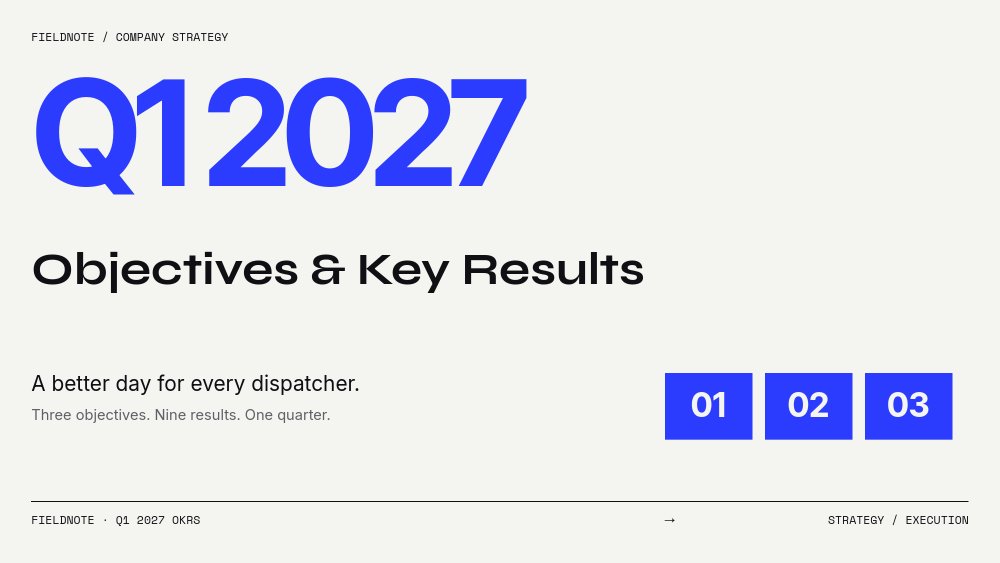
An OKR template for leaders who are tired of presenting objectives as a spreadsheet. Fieldnote, a fictional field-service scheduling startup, opens its Q1 2027 plan with "Q1 2027" in massive ultramarine numerals, "Objectives & Key Results" in wide Syne capitals, and three blue numeral tiles - 01, 02, 03 - that promise the shape of what follows. The line underneath sets the tone for the whole strategy deck: "Three objectives. Nine results. One quarter."
#What Makes This Template Stand Out
The classic OKR table is broken into panes that people can actually follow. Before any objective, a strategy pane states the bet in huge type - "Win the mid-size fleets." - with three context stats that roll up on entry: 2,400 target accounts, 18% win rate today, $310 customer acquisition cost. Then each objective takes a full pane. "Make onboarding a non-event", "Be the tool dispatchers open first", and "Grow without growing the team" each carry three key results, and every result shows a TODAY value, a TARGET value, a progress bar, and a bold attainment percentage. Nobody has to cross-reference a column header.
The numeral is the deck's camera subject. One shared block holds a giant ultramarine objective number that sits on the left edge for 01, swings to the right edge for 02, and returns left for 03, rolling to its new digit as it moves. The objective title and key result rows trade sides to make room, so the three objective panes feel like one continuous move. The visual system is strategy-paper bold: chalk-white field, ink-black Syne headlines, Inter Tight numerals, Space Mono labels, and a single saturated ultramarine for everything that matters.
Accountability and cadence finish the story. The ownership pane - "One owner. Clear accountability." - gives each objective a named owner card with a black-and-white portrait on an ultramarine panel: Maya Shah for product, Jordan Cole for engineering, Nina Park for growth. The rhythm pane draws a Jan / Feb / Mar timeline with three phases (Baseline & commit, Review & unblock, Score & decide), a "FRIDAYS / 20-MINUTE CHECK-IN" note, and a "QUARTER REVIEW / MAR 31" chip. A persistent footer carries previous and next arrows wired with click actions, so the deck navigates the same way in a browser, an embed, or a code export.
- One pane per objective with three key results, each showing TODAY, TARGET, a progress bar, and attainment
- Traveling objective numeral that swings left, right, and left again while it rolls from 01 to 03
- Progress fills that scale in from the left while every value number-rolls
- Ownership pane with three named owner cards and a Jan / Feb / Mar operating rhythm with a drawn timeline
- Persistent footer with previous and next arrows wired as click actions that survive HTML and code export
- 8-pane 16:9 deck in Syne, Inter Tight, Inter, and Space Mono on chalk white with one ultramarine accent
#Who Should Use This Template
- Founders and CEOs presenting company OKRs at the start of a quarter. The strategy pane gives the "why" before the objectives give the "what".
- Department heads - product, engineering, growth, customer success - translating company goals into their own three objectives and nine results.
- Chiefs of staff and strategy leads who run the OKR process and need a format teams will actually read instead of skim.
- Product managers aligning a squad around quarterly outcomes, then reusing the same deck at the mid-quarter check-in with updated bars.
#Best Use Cases
#Quarterly Kickoff and OKR Strategy Deck
Present the deck live at the all-hands from a hosted link. The rhythm of one objective per pane gives each owner a natural moment to speak to their results, and the closing pane - "Three objectives. Nine results. One quarter." with "One quarter." in ultramarine - lands the message before questions.
#Mid-Quarter Check-Ins
Duplicate the project each check-in, update the TODAY values and the fill widths, and present the new version. Because the bars animate from the left on every pane entry, the room sees progress being made rather than reading a cell that changed color. Keep the earlier versions as a record of how the quarter moved.
#Board and Investor Context
Export to PDF and attach the OKR deck to a board pack or monthly investor update. Leadership gets the strategy, the targets, today's baseline, and who owns what in eight pages, with the operating rhythm showing how progress will be reported.
#How to Customize This Template
- Open PaneFlow and choose "OKR & Strategy - Three Objectives" from the template gallery
- On the cover, replace "Q1 2027", "FIELDNOTE / COMPANY STRATEGY", and "A better day for every dispatcher."
- Update the persistent footer text "FIELDNOTE · Q1 2027 OKRS" and "STRATEGY / EXECUTION" once for every pane
- Rewrite the strategy statement "Win the mid-size fleets." and its three context stats and labels
- For each objective pane, replace the two-line title, then edit each key result label, TODAY value, TARGET value, and attainment percentage
- Resize each ultramarine fill shape so it matches the new percentage on its track
- Swap the owner portraits, names, functions, and one-line mandates on the ownership pane, then adjust the three rhythm phases and the review date
- Preview the numeral swings and footer arrows, then publish as a hosted link or export to PDF for the team
#Related Templates
- Product Roadmap - Now / Next / Later - the roadmap that delivers these objectives
- Quarterly Business Review - Donut & Bars - grade last quarter before setting the next one
- Go-to-Market Plan - Tangerine Pop - another operator-voiced planning deck with number-roll goals
- Hiring 101 - Cedar Workshop - an internal workshop deck in a similarly structured format
#Related Resources
- PaneFlow for Startups - strategy, board, and fundraising decks for small teams
- PaneFlow for Product Managers - OKRs, roadmaps, and planning presentations
- PaneFlow for SaaS - metric-driven decks that export to code and PDF
Start with OKR & Strategy - Three Objectives
Open this template in PaneFlow, customize it to match your brand, and export as HTML, React, Vue, or video.