Startup Pitch - Soft Gradient Rounds Template
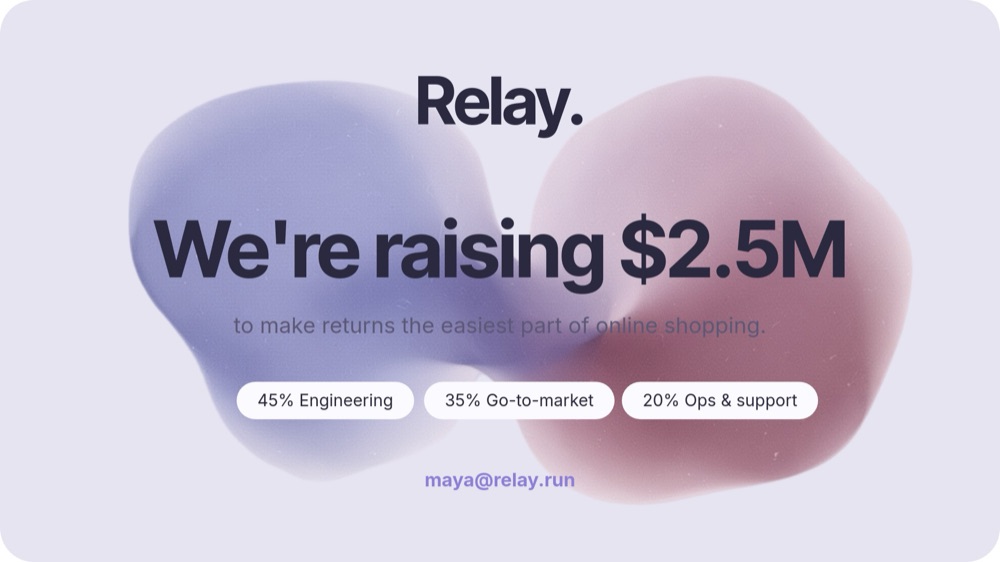
An 8-pane seed deck for founders who want polish without theater. Soft lilac background with blurred gradient blobs, big rounded containers, plum-slate dark panes for contrast, and a fictional parcel-returns platform called Relay carrying the full arc from "Returns are broken." to "We're raising $2.5M". The aesthetic is quietly confident - the deck of a team that expects the numbers to do the persuading.
#What Makes This Template Stand Out
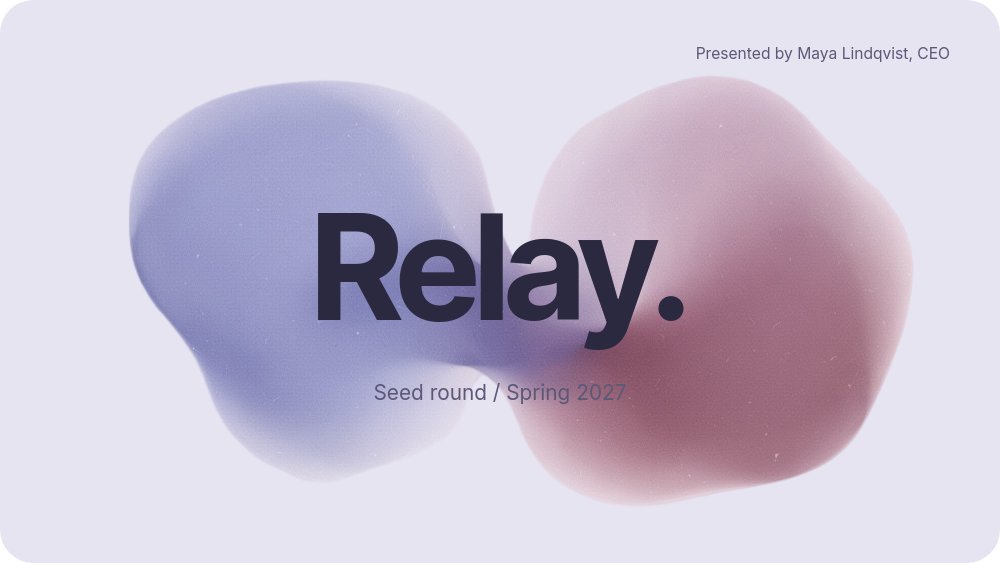
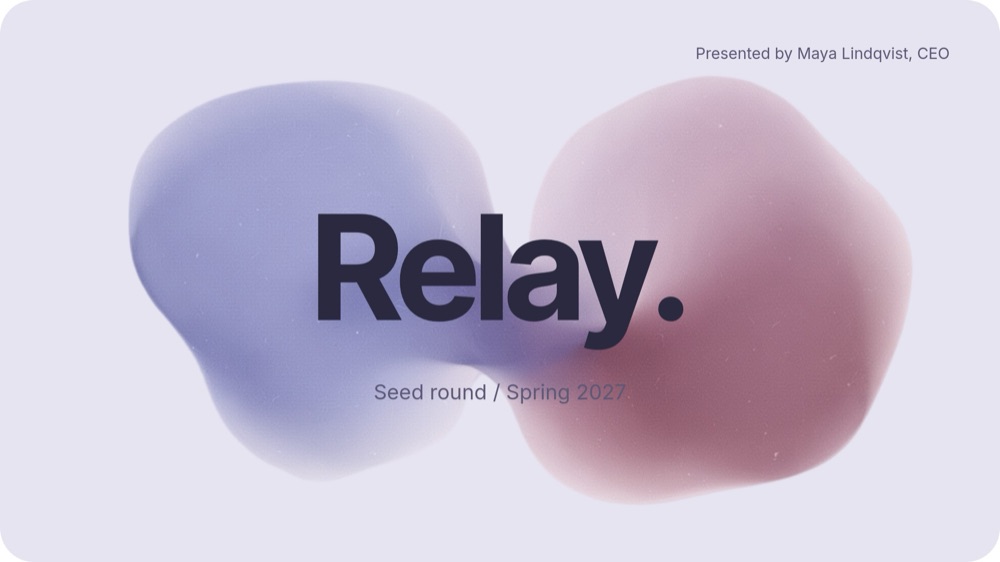
The wordmark makes a journey. "Relay." opens the cover at around 280px, centered over two blurred lilac-and-plum shapes, with only "Seed round / Spring 2027" beneath it. On every following pane the same wordmark shrinks to a top-left thumbnail with a miniature of the gradient blobs, while a rounded section chip top-right tracks the narrative: 01 / Problem through 06 / Team. By the ask, the wordmark rides back to center over the same blobs - the deck closes the loop it opened.
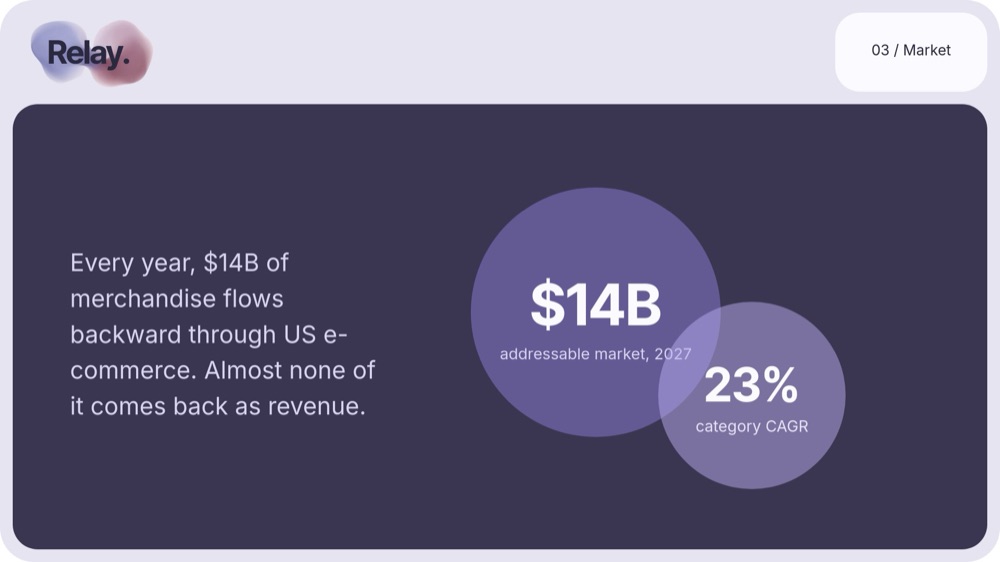
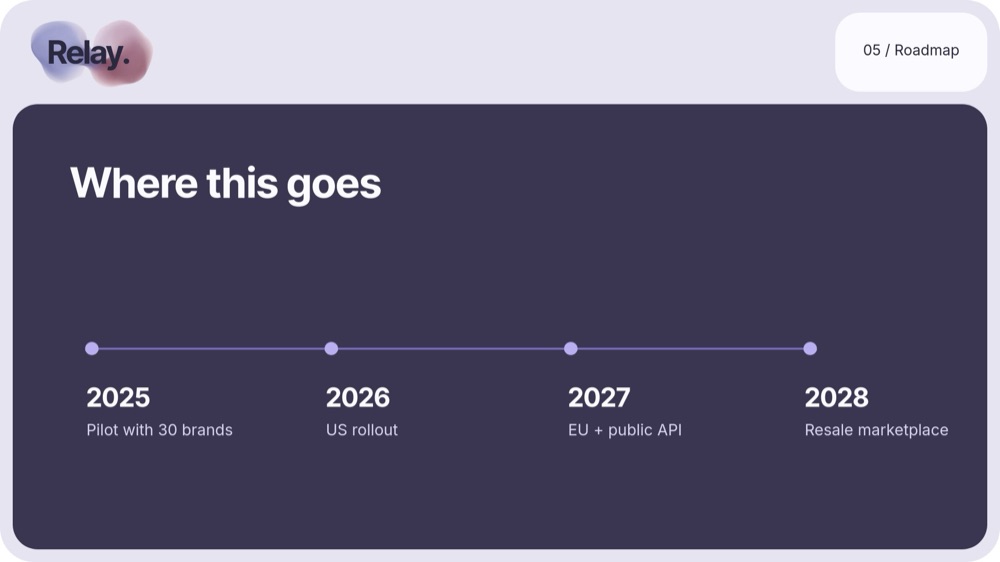
Light and dark panes alternate with intent. The problem, solution, traction, and team panes run light - white rounded cards on soft lilac - while the market and roadmap go full plum slate. The dark market pane stages two overlapping translucent circles ($14B addressable market, 23% category CAGR) as the deck's one data-visualization flourish, and the dark roadmap draws a single line through four dots: 2025 Pilot, 2026 US rollout, 2027 EU + public API, 2028 Resale marketplace.
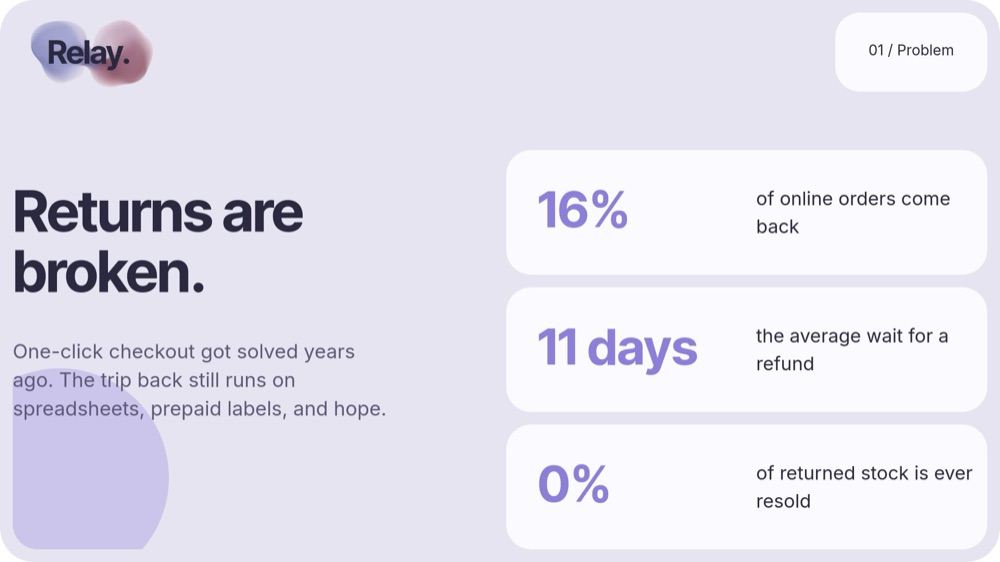
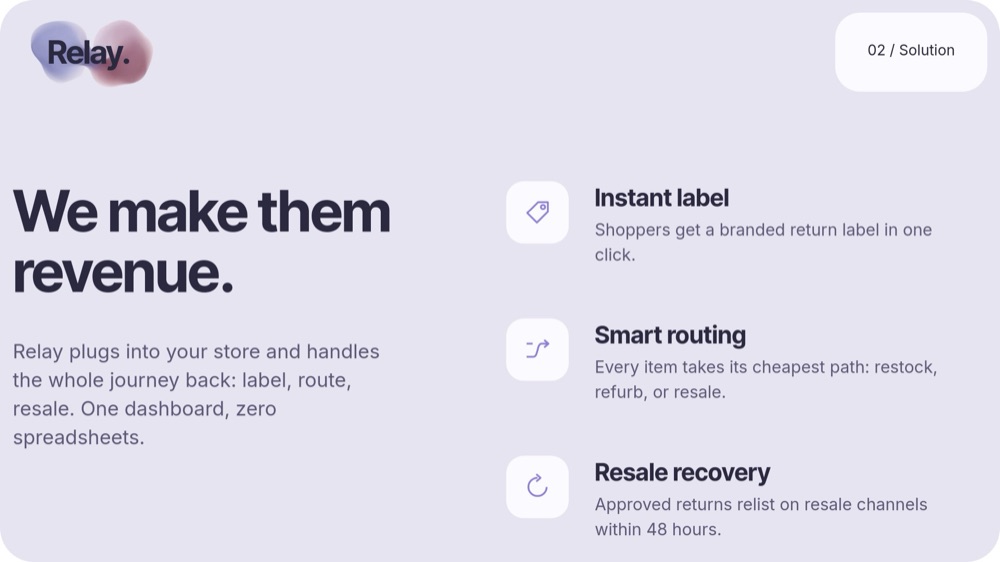
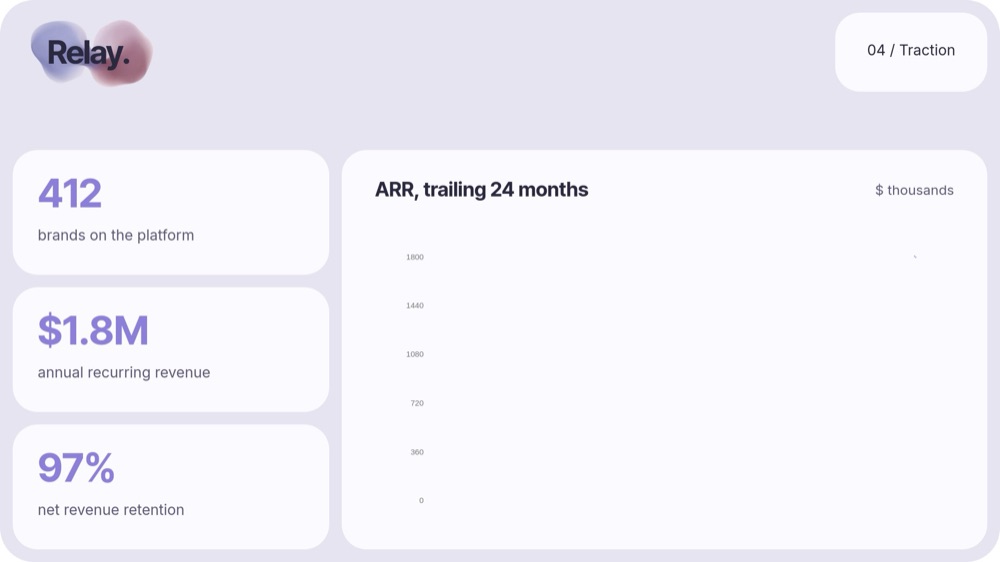
Every number moves, but nothing shouts. The three problem cards roll their stats (16% of orders come back, 11 days to a refund, 0% of returns resold), the traction pane rolls 412 brands, $1.8M ARR, and 97% retention next to a 24-month ARR line chart, and entrances are short fades with gentle staggers. The copy holds the same temperature: "Returns are broken." answered by "We make them revenue." - declarative founder-speak with no adjectives doing the lifting.
- Soft lilac stage with blurred gradient blobs, alternating with plum-slate dark panes
- Traveling "Relay." wordmark: giant on the cover, top-left thumbnail throughout, centered again for the ask
- Rounded section chip tracking the narrative from 01 / Problem to 06 / Team
- Number-roll on every stat, from the 16% problem card to $1.8M ARR
- Overlapping market circles, a 24-month ARR line chart, and a drawn four-dot roadmap timeline
- Eight panes covering the full seed arc: cover, problem, solution, market, traction, roadmap, team, ask
#Who Should Use This Template
- Seed and Series A founders who need a deck that reads as composed rather than template-shaped. The rounded-card system and restrained motion signal a team in control of details.
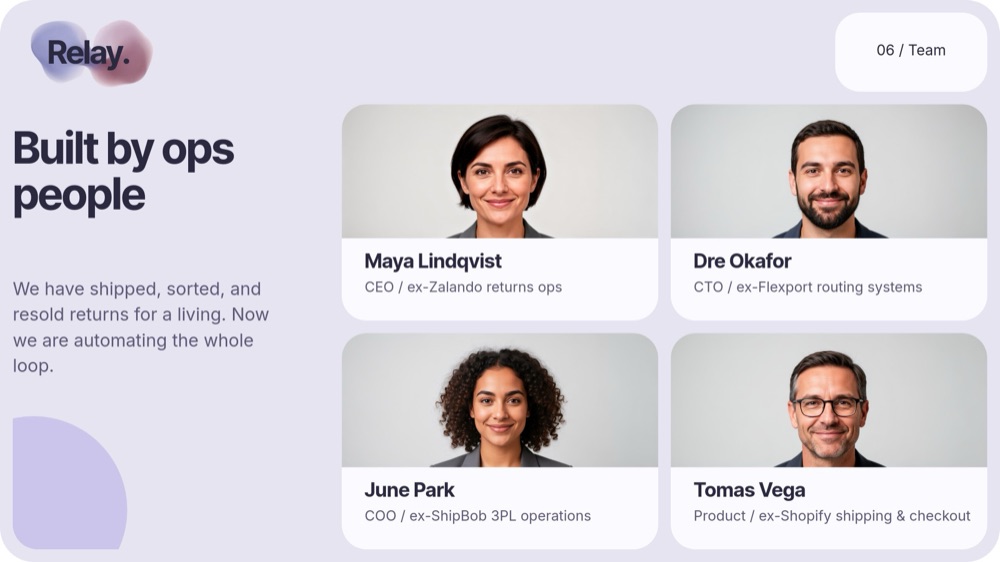
- Ops, logistics, and B2B platform startups for whom the Relay placeholder is nearly a first draft - the problem stats, the three-part solution, and the ops-credentialed team grid map directly.
- Accelerator cohorts preparing for demo day who need the canonical eight-pane arc already structured, with the timing and animation work done.
- Product managers pitching internal initiatives - the same problem-to-ask narrative works for budget asks, with the funding chips repurposed as resourcing.
#Best Use Cases
#Investor Meetings and Demo Days
Present from the hosted link or HTML export and the deck paces itself: stats roll as each pane enters, the market circles fill, the roadmap line draws while you talk through the milestones. Eight panes is deliberately tight - the deck holds the meeting's spine and leaves the appendix questions for conversation.
#The Email-Ahead Deck
Send the published PaneFlow link before the meeting. Partners skim it in ninety seconds, the animations make the traction pane land harder than a static chart, and because the link points at the live project, you can fix a number the night before without re-sending. Export to PDF when the fund's process requires an attachment.
#Internal and Board Updates
Reuse the structure after the raise: the traction pane becomes the monthly metrics review, the roadmap pane tracks delivery against the same four milestones you pitched, and the ask pane becomes the quarter's priorities. Keeping the same visual system between the fundraise and the board pack reads as continuity.
#How to Customize This Template
- Open PaneFlow and select "Startup Pitch - Soft Gradient Rounds" from the template gallery
- On the cover, replace the "Relay." wordmark with your name, update "Seed round / Spring 2027", and edit the presenter line top-right
- Rewrite the problem pane: the "Returns are broken." headline, the supporting paragraph, and the three rolling stat cards
- Update the solution pane's "We make them revenue." answer and the three icon rows (Instant label, Smart routing, Resale recovery) with your own product pillars
- Put your real TAM and growth rate in the two overlapping circles on the dark market pane
- Edit the traction pane's three metric callouts and feed the ARR chart your own 24-month series
- Rename the four roadmap milestones on the timeline, keeping one beat per year
- Replace the four team headshots and one-line creds on the "Built by ops people" grid
- Update the ask - amount, the three use-of-funds chips, and the contact email - then publish as a link, or export to PDF or video
#Related Templates
- SaaS Pitch - Minimal - the stripped-down pitch when even soft gradients are too much
- Consumer Brand Pitch - Linen Serif - the warmer, editorial register for consumer-facing raises
- Stats Band - Number Roll Strip - the homepage metrics band for the product the deck is funding
- Feature Tour - SaaS Section - the product walkthrough to pair with the deck on your site
#Related Resources
- PaneFlow for Startups - pitch decks and launch assets that move
- PaneFlow for SaaS - product storytelling from deck to homepage
- PaneFlow vs Pitch - how PaneFlow compares to Pitch for animated, exportable decks
Start with Startup Pitch - Soft Gradient Rounds
Open this template in PaneFlow, customize it to match your brand, and export as HTML, React, Vue, or video.