Marketplace Pitch Deck Template - Playful Illustrated
A marketplace pitch deck template for two-sided startup founders who want investors to feel the energy of the network, not just read the math behind it. 10 panes carry a playful Memphis-postmodern aesthetic - pink, teal, and yellow shapes on a warm cream canvas with deep navy ink - through the full marketplace investor arc, from supply and demand pains all the way to the network-effects flywheel and the round.
#What Makes This Template Stand Out
The defining choice in this template is dual-sided storytelling. Most pitch decks treat the company as one thing pitching one customer. A marketplace is two products, two acquisition motions, and two unit economies stacked on top of each other, and a generic deck flattens that. Here, the problem pane runs supply pain on the left and demand pain on the right. The product pane shows a maker dashboard next to a buyer browsing screen, side by side. The solution pane uses a literal three-circle match diagram - a pink "Makers" circle, a yellow brand circle in the middle, a teal "Buyers" circle on the right, with arrows pointing inward. By the time investors reach traction, they already understand which side you grew first and how the loop closes.
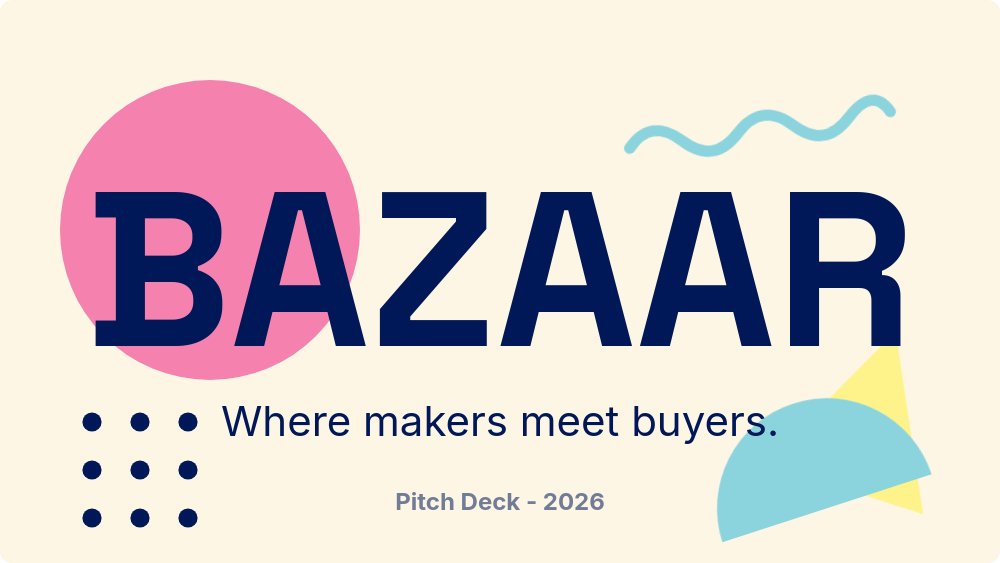
The aesthetic is Memphis postmodern, toned down for an investor room. The cover sets the wordmark huge in navy with a pink circle behind the first letter, a teal squiggle in the corner, and a yellow geometric shape grounding the layout. Headlines use Space Grotesk 700 in deep navy on warm cream, body copy is Inter, and the only motion you will see is pop-in on shapes, succession on metric stacks, and letter-fade on the headlines. There are no looping animations, no gradients, no decorative chrome - the energy comes from the geometry and the palette, not from motion overload.
The 10-pane sequence follows the marketplace investor arc. Cover, dual-column problem, why-now cultural shift, the match-diagram solution, supply-side and demand-side product screenshots, GMV traction with chart and three big numbers, three-tier market sizing in nested circles, the network-effects flywheel illustrated as connected nodes, casual founder portraits, and a clean ask. Pane 6 is the math pane - the chart card on the left animates a multi-quarter GMV curve while three stat callouts on the right (last-quarter GMV, active makers plus buyers, MoM compounding) land the headline.
- 10-pane structure mapped to the two-sided marketplace investor arc
- Playful Memphis-postmodern palette: cream background, navy ink, pink, teal, and yellow accent shapes
- Side-by-side dual-column layout for supply pain vs demand pain and supply UI vs demand UI
- Animated GMV traction chart paired with three big-number callouts on a single pane
- Three-circle match diagram on the solution pane and nested TAM, SAM, SOM rings on the market pane
- Pop-in shapes, succession on metric stacks, and letter-fade headlines - no looping motion
#Who Should Use This Template
- Two-sided marketplace founders raising seed or Series A who need investors to grasp both sides of the network without losing energy. The dual-column layouts and the match diagram do that work for you on the first three panes.
- Talent, services, and creator marketplaces where the supply side is humans, not inventory. The casual founder portraits and the friendly Memphis aesthetic match the vibe of operator-led platforms better than a sterile minimal deck would.
- Secondhand, food, and local marketplaces with strong consumer demand and clear unit economics. The GMV chart, MoM compounding callout, and TAM rings give you somewhere to put the math without making the deck feel like a spreadsheet.
- Founders pitching warm rounds and demo days where the deck has to compete with 30 other slideshows on the same partner's screen. The cream-and-color palette pops against the usual sea of white-and-blue SaaS decks.
#Best Use Cases
#Two-Sided Marketplace Investor Pitches
The deck is built around the questions marketplace investors actually ask: which side do you have, why does the other side want in, what is the take rate, and where is the loop. The dual-column problem pane sets up both sides on slide two so partners do not have to wait until pane 6 to figure out the model. The solution pane locks in the match metaphor, the product panes prove both apps actually exist, and the traction pane shows the GMV curve next to the active-user count so liquidity is legible at a glance. By the network-effects pane, the flywheel reads as the natural conclusion of everything that came before it.
#Demo Days and Pitch Competitions
Marketplace decks often compete in cohort demo days where the audience is mostly generalist investors scanning many decks back to back. The Memphis shapes and the cream-and-navy palette stand out against the usual minimal-SaaS aesthetic, which earns you the extra two seconds of attention you need on the cover and problem panes. Set autoplay to your script timing and the deck plays as a self-paced 5-to-10-minute walkthrough.
#Marketplace Updates to Existing Investors
After the round closes, the same template works as a quarterly update. Swap the ask pane for a "what we shipped this quarter" pane, update the GMV chart and the three traction callouts, and export to PDF or publish to a private link. The dual-side framing makes it easy to show how supply and demand grew separately and where they met in the middle.
#How to Customize This Template
- Open PaneFlow and select "Marketplace Pitch - Playful Illustrated" from the template gallery
- Replace the wordmark on the cover pane with your marketplace name and update the dateline
- Edit the supply-side and demand-side problem columns with the real pains you heard from interviews
- Swap the maker dashboard and buyer browsing screenshots with your own app screens
- Update the GMV chart values and the three traction callouts (last-quarter GMV, active users, MoM growth)
- Adjust the TAM, SAM, and SOM numbers and labels in the nested-circle market pane
- Replace the founder portraits with casual editorial shots of your team
- Set the round amount and milestones on the ask pane, then export as PDF or publish to a link
#Related Templates
- DTC Pitch - Bold - bold consumer brand pitch deck for ecommerce-led startups
- SaaS Pitch - Minimal - the minimal counterpart for B2B SaaS founders raising seed or Series A
- Apparel Collection - editorial product showcase for consumer brands and lookbooks
- Beauty Drop - Luxe - luxe beauty product launch for cosmetics and DTC brands
#Related Resources
- PaneFlow for Startups - pitch decks, demo day decks, and investor updates for early-stage founders
- PaneFlow for SaaS - animated decks, product tours, and feature reveals built for SaaS and platform teams
- PaneFlow vs Canva - how PaneFlow compares to Canva for animated pitch decks
Start with Marketplace Pitch - Playful Illustrated
Open this template in PaneFlow, customize it to match your brand, and export as HTML, React, Vue, or video.